

এক যুগপুরুষের স্মৃতিতে আমাদের আয়োজন – Remembering Gopal Mukherjee
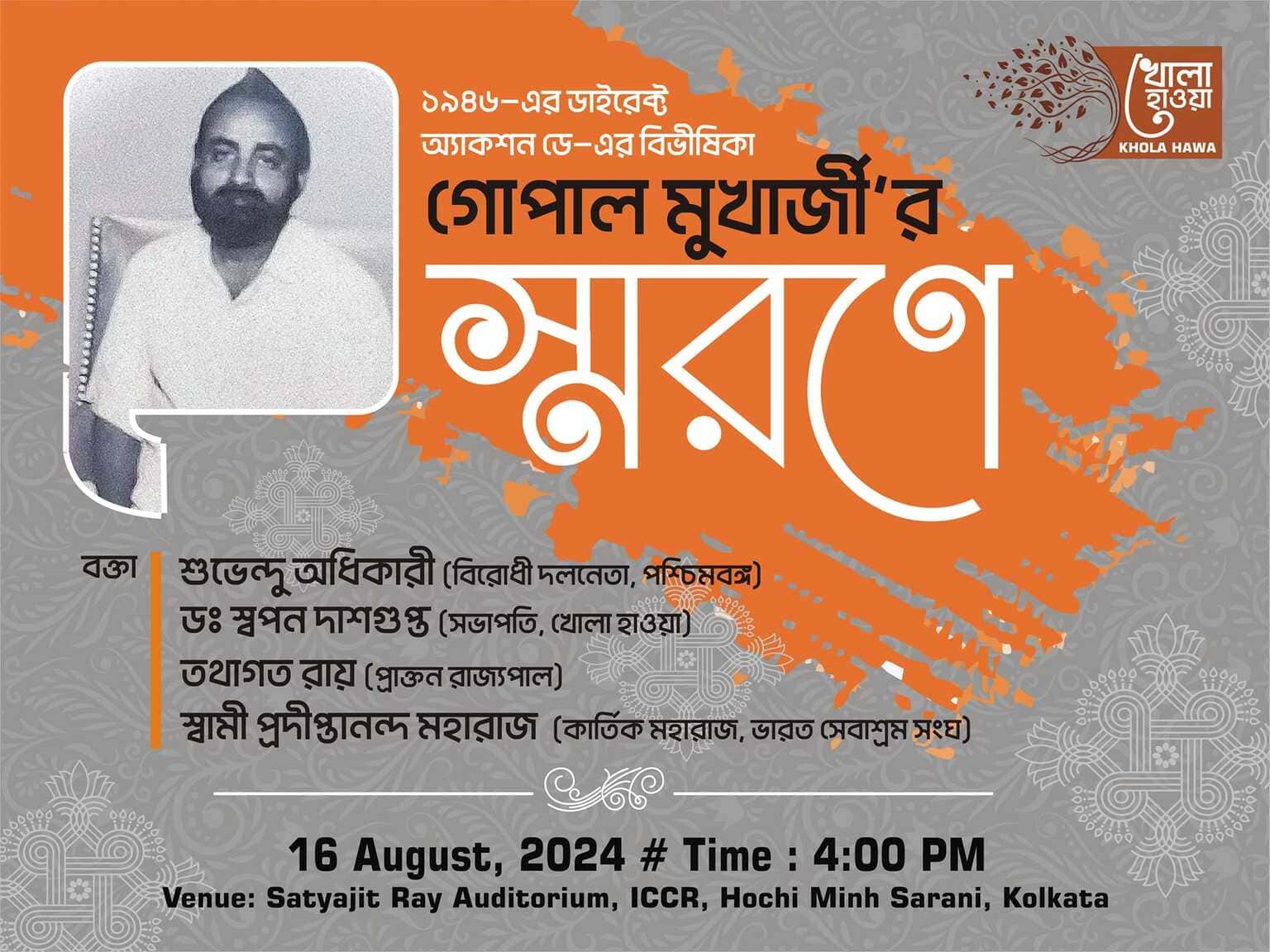
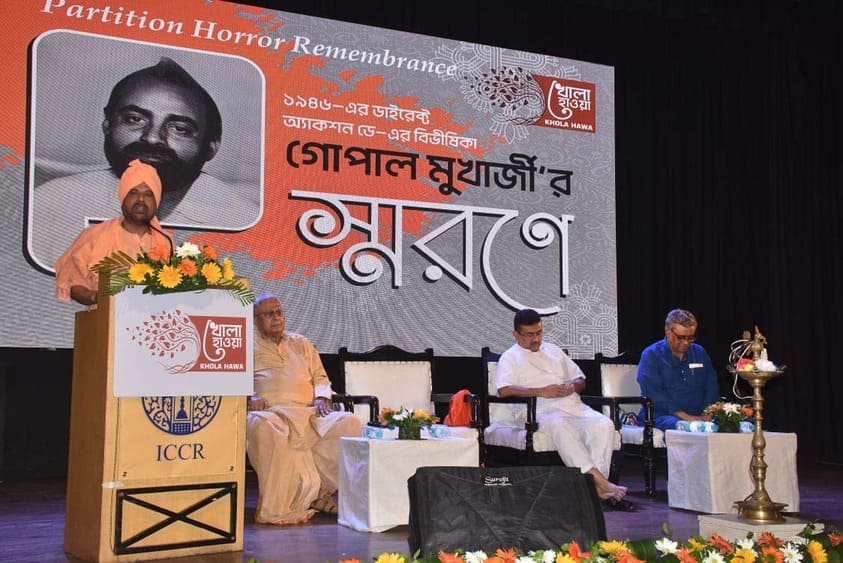
On 16 August 2024, Khola Hawa, a socio-cultural organisation, organised a commemorative programme. Gopal Chandra Mukherjee, popularly known as Gopal Patha, was a controversial yet significant figure in the history at the Satyajit Ray Auditorium, ICCR, Kolkata. The event, held on the day that marks the tragic Direct Action Day of 1946, paid tribute to the life and legacy of Gopal Mukherjee, popularly known as “Gopal Pantha,” whose courage and leadership left an indelible mark on Bengal’s socio-political history.
The programme began with a cultural performance, followed by the screening of a documentary video that provided historical context to the occasion.
The formal session then featured distinguished speakers—Shri Suvendu Adhikari, Leader of Opposition in the West Bengal Legislative Assembly; Dr. Swapan Dasgupta, Member of Parliament (Rajya Sabha) and President of Khola Hawa; Shri Tathagata Roy, Former Governor; and Swami Pradiptananda Maharaj of Bharat Sevashram Sangha. Each offered a unique perspective on Gopal Mukherjee’s contributions, ensuring a multi-dimensional remembrance.
- Shri Suvendu Adhikari underlined the importance of preserving the memory of regional icons like Gopal Mukherjee, who often remain outside mainstream historical accounts. He stressed that Mukherjee’s leadership during the volatile days of 1946 exemplified courage, organisational ability, and commitment to protecting the vulnerable. He urged that Bengal must not forget such figures who shaped the destiny of communities during one of the most critical times in its history.
- Swapan Dasgupta focused on situating Gopal Mukherjee in the broader canvas of India’s political and social evolution. He observed that Mukherjee was emblematic of how grassroots leadership could decisively influence events in ways official structures could not. At the same time, he highlighted the need for a balanced assessment—acknowledging the complexities of his role without overlooking the historical context of communal tensions and Partition.
- Shri Tathagata Roy drew upon his deep understanding of Bengal’s political past to portray Gopal Mukherjee as a man whose impact was felt far beyond his immediate circle. He emphasised that local leaders like him were often pivotal in shaping social outcomes, even if their stories were marginalised in mainstream history. He noted that remembering Mukherjee is crucial not only for understanding the past but also for recognising the role of collective courage in present times.
- Swami Pradiptananda Maharaj offered a spiritual dimension, reflecting on the dharmic values that underpinned Gopal Mukherjee’s sense of responsibility and fearlessness. He reminded the audience that true leadership is rooted in sacrifice, duty, and moral clarity, and that these qualities continue to inspire society whenever it faces adversity. His remarks brought an ethical and philosophical depth to the discussion, linking Mukherjee’s actions to timeless ideals of service and protection.
The speakers collectively highlighted that while Gopal Mukherjee remains a contested figure in some narratives, his presence during the 1946 crisis is undeniable and forms an essential part of Bengal’s historical memory. They also stressed the need for initiatives such as this commemoration to reclaim forgotten legacies and to encourage critical engagement with the region’s past.
The event concluded with a call to view remembrance not as a passive act but as an active process of drawing lessons from history. In honouring Gopal Mukherjee, “এক যুগপুরুষের স্মৃতিতে আমাদের আয়োজন” reaffirmed the value of resilience, unity, and leadership—qualities that remain deeply relevant for contemporary society.