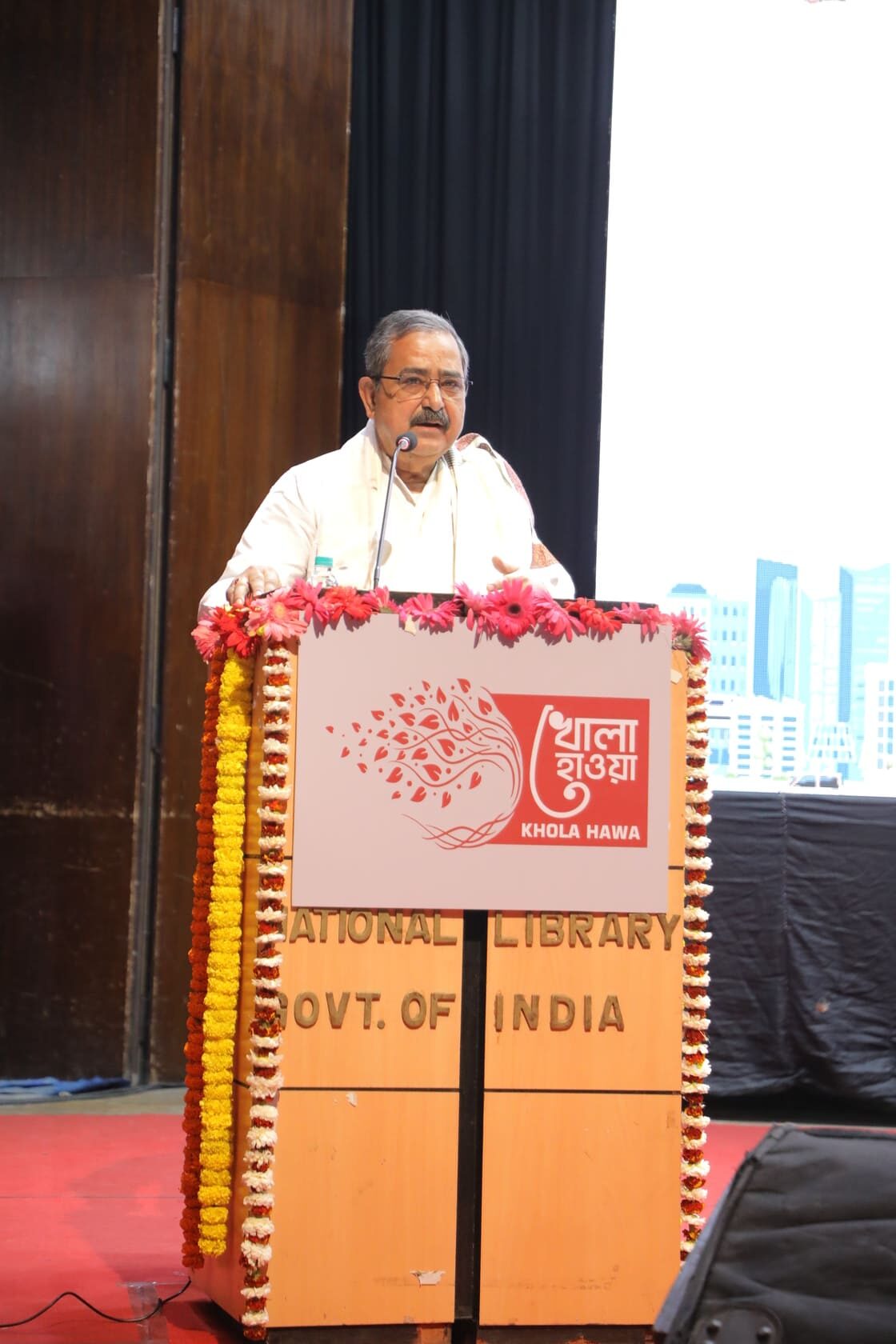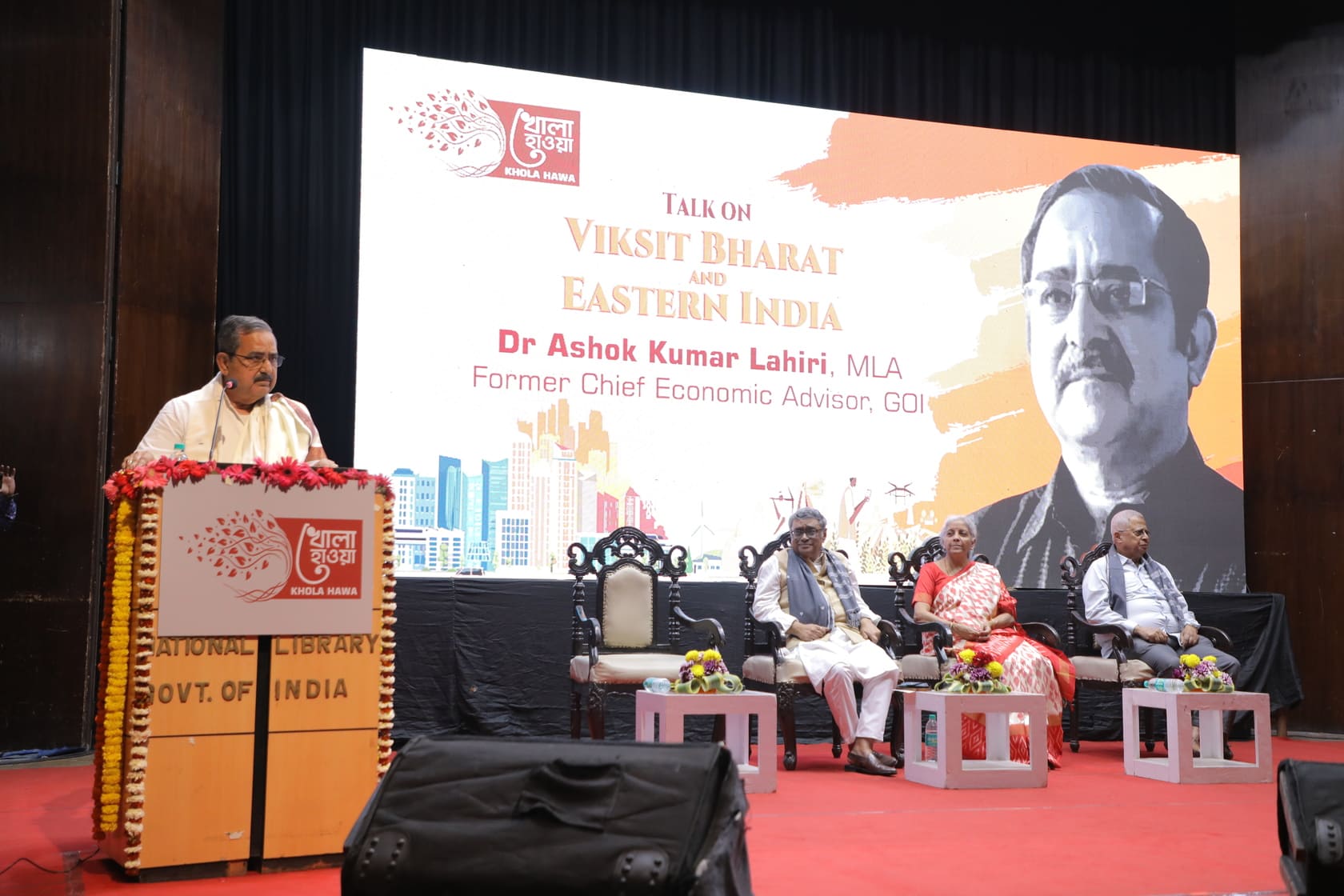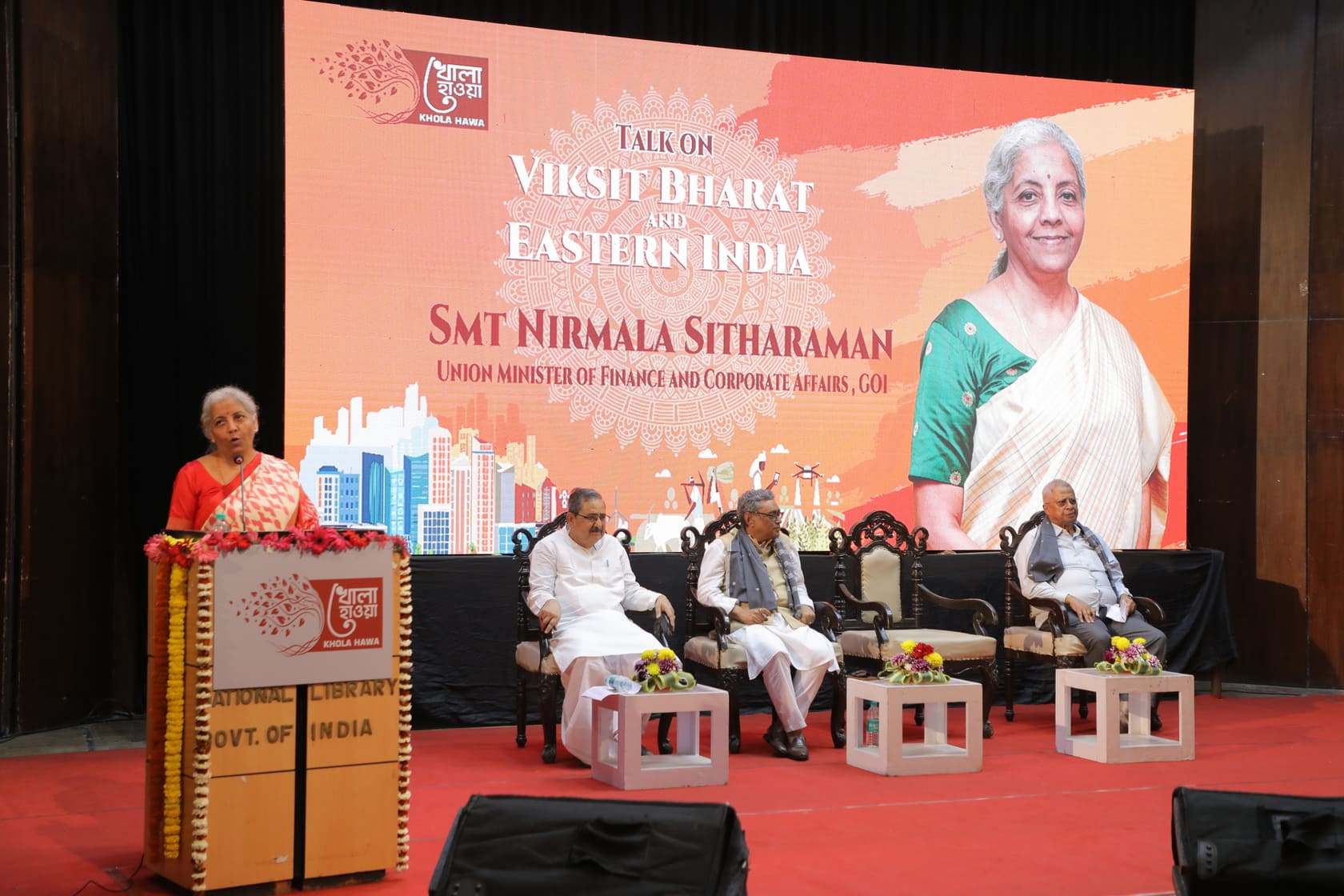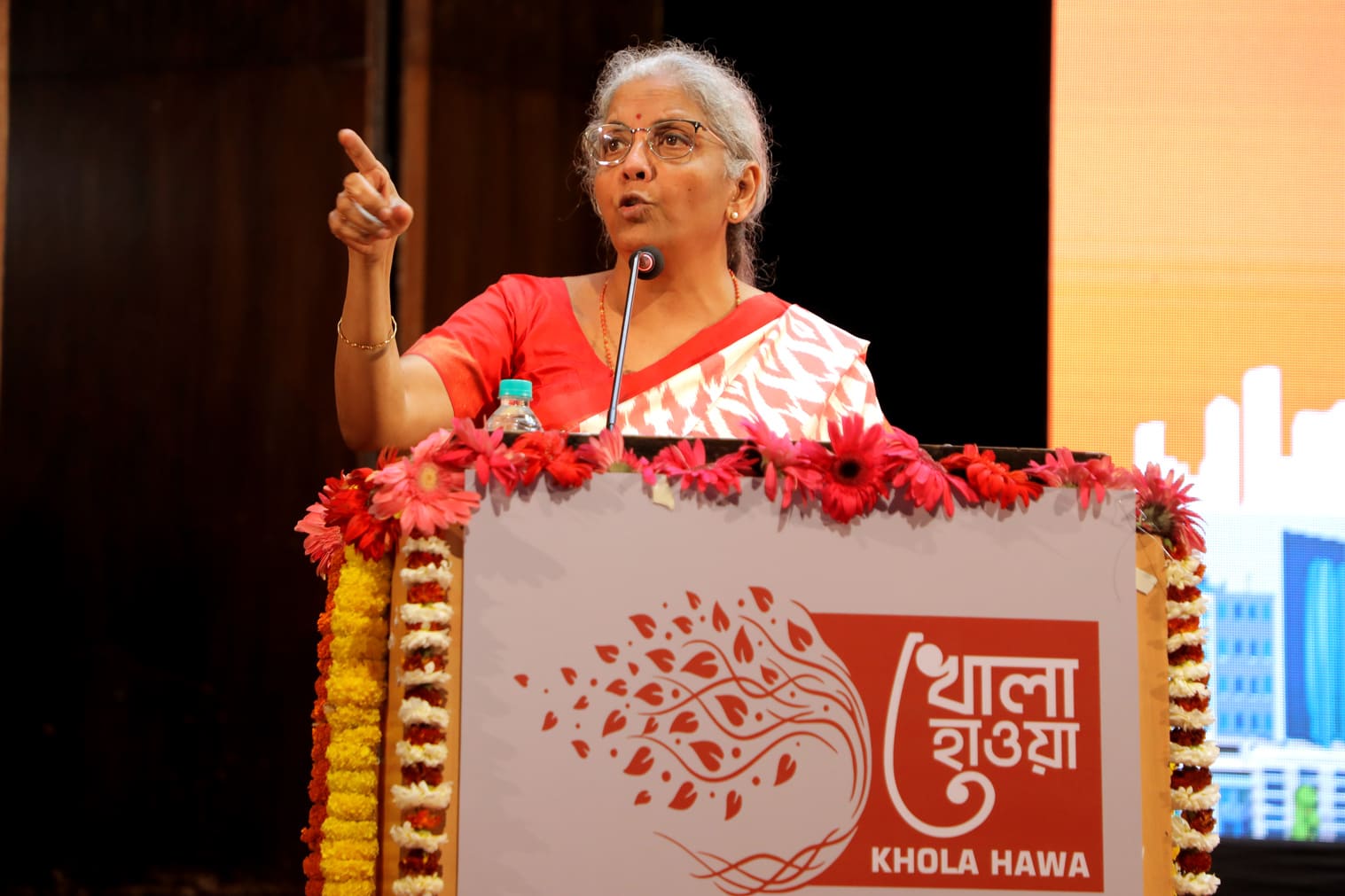


Kolkata, Feb 27:Union Finance Minister Nirmala Sitharaman, addressing a packed audience at the Bhasha Bhawan, National Library, Kolkata, emphasized the urgent need for West Bengal and Eastern India to actively participate in India’s journey towards becoming a developed nation by 2047. The event, organized by Khola Hawa, featured former Chief Economic Advisor Dr. Ashoke Kumar Lahiri and former Governor Shri Tathagata Roy as special guests.
The session was part of a larger dialogue on “Viksit Bharat and Eastern India”, with Sitharaman presenting a sobering assessment of the region’s developmental challenges and missed opportunities.
Following her felicitation, the finance minister thanked Khola Haowa president Dr. Swapan Dasgupta and expressed regret for missing Dr. Lahiri’s full address. She then delivered a wide-ranging speech analyzing West Bengal’s socio-economic decline and urging a cooperative federal approach to ensure inclusive growth.
Reiterating Prime Minister Narendra Modi’s vision of “Viksit Bharat @ 2047”, Sitharaman said that Eastern India—particularly West Bengal, Bihar, Odisha, and Jharkhand—must become engines of national growth. She highlighted the government’s development philosophy centered on empowering the four key pillars of society: Women, Youth (Yuva), the Poor, and Farmers (Annadata).
Sitharaman was critical of West Bengal’s lack of engagement with central welfare initiatives. She pointed out that the state had not nominated a single district under the Aspirational Districts Programme, a move that has disadvantaged it compared to its neighbors.
The non-adoption of major central schemes, including Ayushman Bharat, PM-KISAN, PM Matsya Sampada Yojana, Swamitva Yojana, and Kisan Credit Card loans, was highlighted. The state’s implementation of MGNREGA is also under scrutiny, with 25 lakh fake job cards and a ₹100 crore scam in the midday meal scheme involving over-reporting of 160 million meals.
Once a beacon of industrial growth, West Bengal’s contribution to the national industrial output has dropped from 24% in 1947 to 3.5% in 2021. The Gross Capital Formation has declined from 6.7% in 2010 to 2.9%, while the state has also seen a massive outmigration, with over 1.1 million people leaving between 2010 and 2025.
Bengal, which once ranked second only to Kerala in literacy, now trails behind states like Tamil Nadu, Gujarat, and Maharashtra. The per capita income growth, which once outpaced the national average in the 1990s, has stagnated, ranking the state 23rd nationally in 2021–22.
Despite receiving central assistance for developing 1,100 km of railway lines, 21,000 km of rural roads, and 1,200 km of national highways, West Bengal has struggled to attract and retain industrial investments. Business conglomerates such as Dabur, Aditya Birla Group, and Laxmi Mittal have exited the state, citing law and order issues, trade unionism, and political interference.
Residents of West Bengal often travel to Hyderabad and Chennai for medical treatment due to poor local facilities, Sitharaman said. Despite the opening of AIIMS Kalyani, the state government has refused to implement Ayushman Bharat, depriving lakhs of health coverage.
The state’s decline in educational performance, particularly in the 10–14 age group, has raised alarm bells, especially given Bengal’s historical status as an intellectual hub.
The Union Minister also expressed concern over the deteriorating law and order situation in the state. She cited the attack on ED officials during the Sandeshkhali investigation, the deaths of 40 people during the 2023 panchayat elections, and corruption allegations in ration distribution, education, and health schemes. The widespread issue of “cut money” has further eroded trust in governance.
In key developmental metrics, Bengal lags:
- Only 43% of rural households have access to tap water under the Jal Jeevan Mission, compared to the national average of 74%.
- The state’s manufacturing contribution remains weak.
- It has failed to attract Global Capability Centres (GCCs) or develop competitive IT and digital infrastructure, unlike southern states.
Sitharaman offered a roadmap for course correction:
- Reform-driven governance to attract investment and ensure transparency.
- Active implementation of central schemes for healthcare, agriculture, and education.
- Increased investment in education and health to rebuild Bengal’s legacy.
- Leveraging natural resource royalties for local development.
- A renewed commitment to cooperative federalism between the state and the Centre.
In her closing remarks, the finance minister emphasized that the goal of a developed India cannot be achieved without a resurgent East. West Bengal, with its rich legacy and human capital, must reclaim its place in the nation’s economic and intellectual landscape. She called upon the people—especially the youth—to demand better governance, accountability, and inclusive growth.
“Viksit Bharat 2047 will remain incomplete unless Bengal reclaims its potential,” Sitharaman concluded.